
When generative AI arrived, schools did what made sense: they protected assessment. Tasks moved into class, conditions were secured, and teachers added checks to confirm the work was the student's own. That was the right first move. But it is not where we want to end up.
Securing assessment protects our measures, not our students
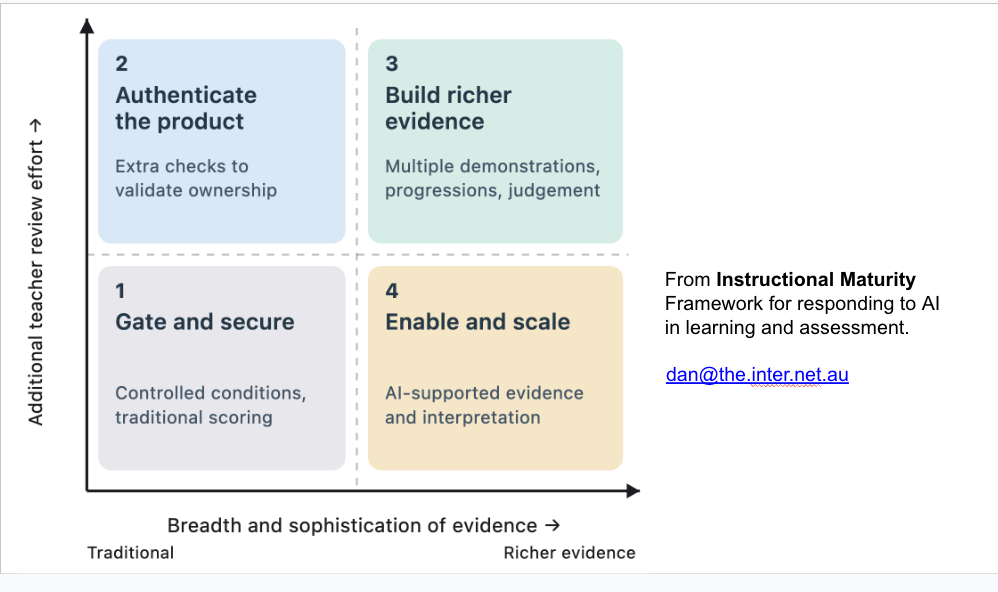
[Slide 12 – the four responses]
Look at how schools are responding. Most start on the left: securing the conditions (gate and secure) and adding checks to authenticate the product. Both protect validity, and both add teacher review effort. Neither helps students with the AI they use every day outside class.
The right-hand side is different. Schools there build richer evidence of learning – several demonstrations across a unit, progressions, professional judgement – and use AI to make that evidence manageable to collect and interpret. Most schools need a mix. The point is to choose deliberately, task by task.
What the evidence says
The OECD's Digital Education Outlook 2026 is clear on the risk. In several studies, students practising with general-purpose AI produced better work but did worse in exams. When AI removes the productive struggle, students finish faster but understand less. The same report finds that tools designed with a clear teaching purpose can lead to better learning outcomes. Pedagogy, not access, decides whether AI helps.
The real challenge is learning design
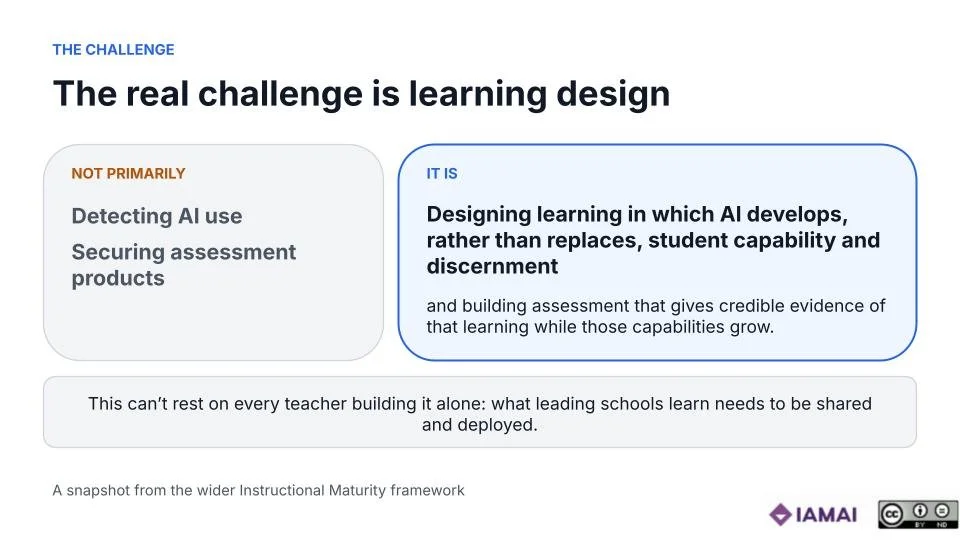
So the real challenge isn't detecting AI or securing the final product. It's designing learning where AI develops, rather than replaces, student capability – and building assessment that gives credible evidence of that learning while those capabilities grow.
That starts with the learning, not the AI. Schools often treat AI use and assessment as single things: students are told what AI they can or can't use for a task. But a task contains different kinds of learning – building knowledge, managing the process, analysis and judgement, reflection and transfer – and AI should play a different role in each.
Learning journeys
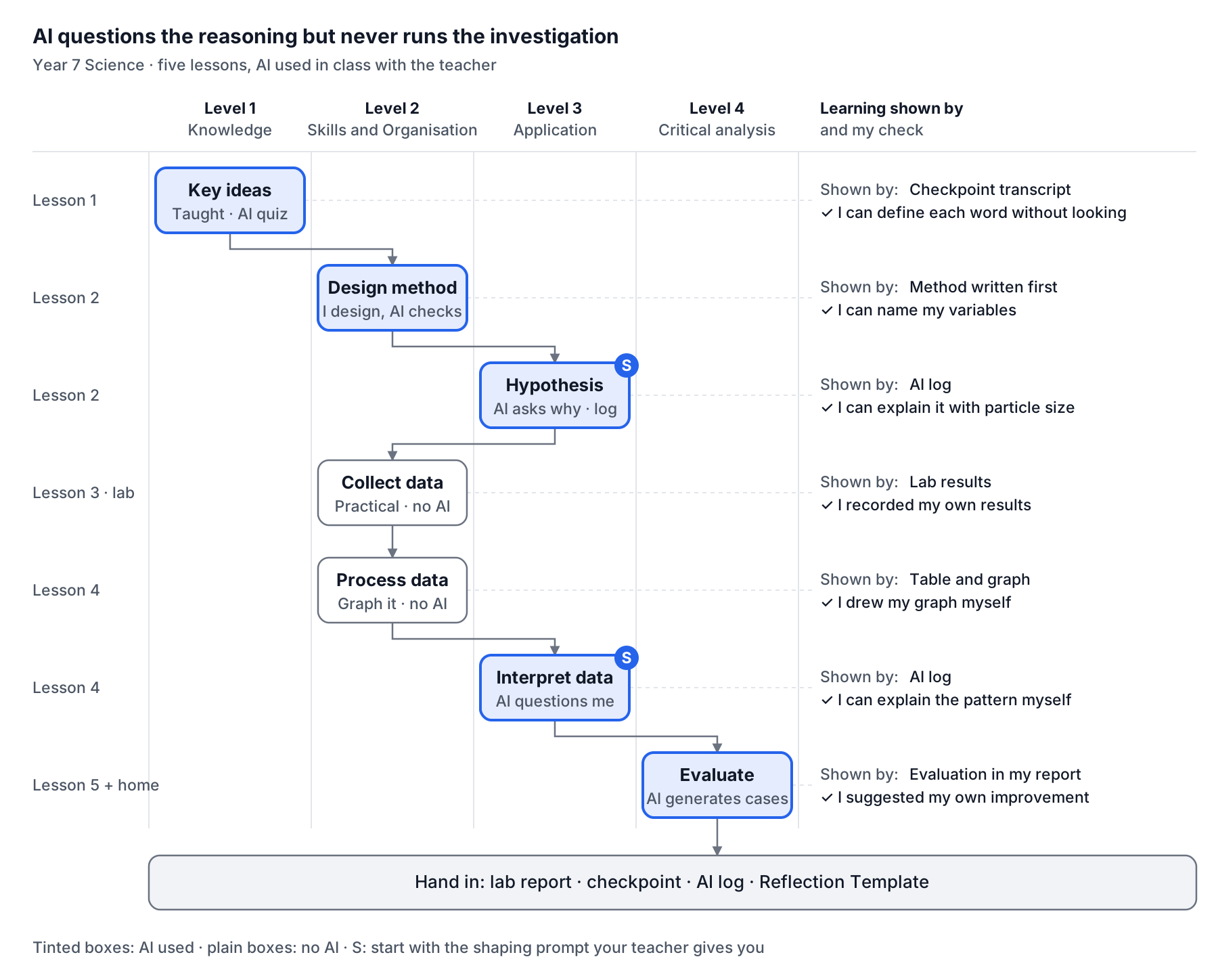
Slide 8 – the Year 9 History journey
A learning journey breaks a unit and its assessment into steps. Each step says what students are learning, whether AI is used and how, and what they show at a checkpoint. In the Year 9 History example, students learn key ideas without AI, check their understanding with an AI quiz, plan their argument and have AI check it, draft in class without AI, then use AI to challenge their draft while keeping a log. By hand-in, the teacher has an essay, a checkpoint, an AI log and a reflection – evidence from several points, not just one product.
This is what I mean by Learning Detection rather than AI Detection. Keystrokes and time-on-task can raise questions about how a product was made. They don't tell you what a student has learned. Checkpoints built into the learning can.
Student discernment: knowing when to step back
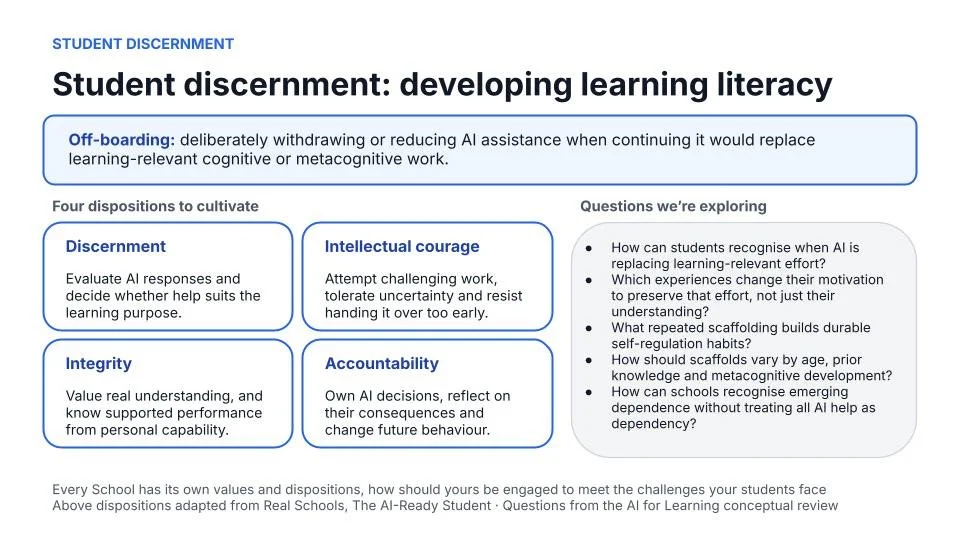
Slide 5.
The harder part is the student. Students and teachers both tell us they don't know what AI is good for in learning. A list of permitted and banned uses doesn't build that judgement. Students need repeated, scaffolded experiences: try it themselves, use AI for a defined purpose, judge what it contributed, then show what they can do without it. We call that last move off-boarding – deliberately stepping back from AI when it would replace the thinking the task is meant to build.
Discernment sits alongside intellectual courage, integrity and accountability. Together they make up what we call learning literacy: students knowing how they learn, what they genuinely know, and how to use AI without handing over responsibility for their own development. Misuse becomes a learning moment, not only a breach of rules.
Making it manageable for teachers
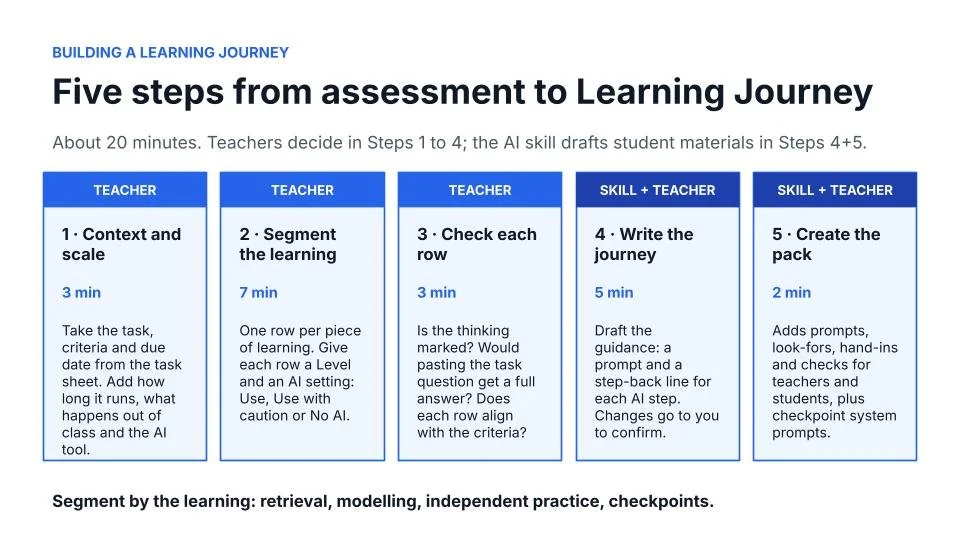
None of this works if every teacher must design it alone. Every unit needs its own prompts, checkpoints and look-fors, and expecting teachers to build those by hand on top of their workload isn't realistic.
So we've built AI tools that do the drafting. Starting from an existing assessment, a teacher sets the context, segments the learning, checks each step, and the tools draft the student prompts, step-back lines, look-fors and checkpoint prompts. The teacher makes every decision; the tools do the writing. These tools run inside the school's own environment, under the school's control.
A path, not a one-off fix
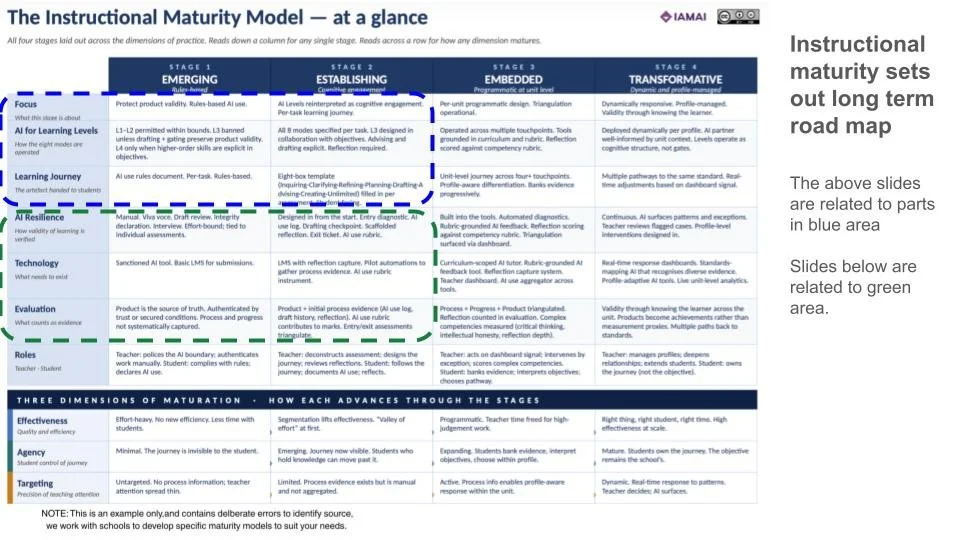
No school will redesign every assessment at once, and none should. The Instructional Maturity framework sets out a progression over several years: from AI traffic lights, to authenticating products, to learning-journey guidance, to richer measures, to students who shape and control the AI they use. Most schools can begin at step three with one or two units.
Join us in 2027
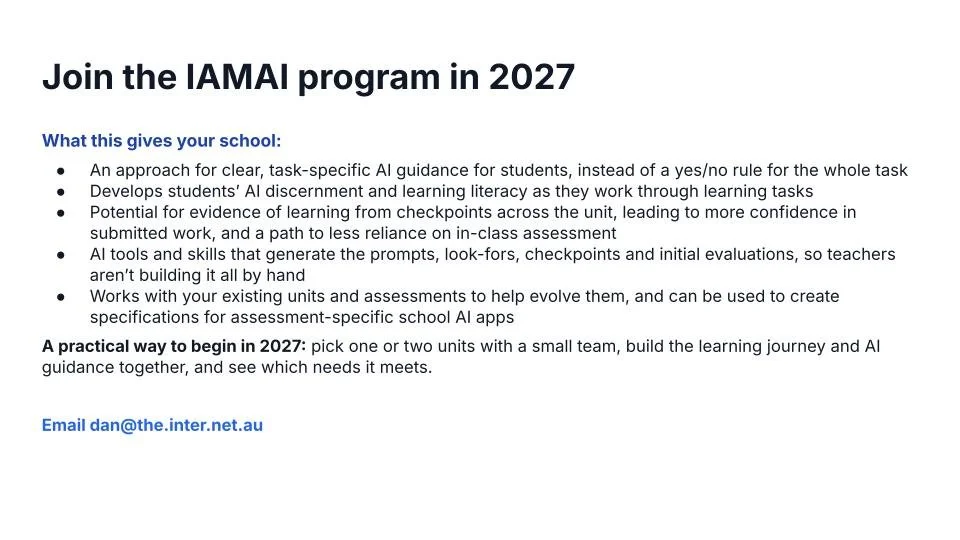
In 2027 I'm bringing together a group of about 10 schools to build this together. Each school picks one or two units, builds the learning journeys with our tools and support, and shares what works with the group, so what leading schools learn is captured and reused rather than rebuilt in every staffroom.
If you'd like your school to be part of it, book a 30-minute conversation [Calendly link] or email dan@the.inter.net.au.
